Quick answer: Ipe and Cumaru are both extremely dense tropical hardwoods that perform well for exterior decking. Ipe is usually chosen for its refined grain, strong dimensional stability, and premium reputation. Cumaru offers a warmer, more varied appearance and is often the better value when budget matters. For most deck projects, the best choice depends on appearance, budget, board profile, fastening method, and installation conditions.
If you are comparing Ipe vs Cumaru decking for a home, commercial project, porch, balcony, or outdoor living space, this guide explains the differences that matter before you order. Amazon Hardwoods supplies Ipe decking and Cumaru decking from Hartford, Connecticut, with pickup and delivery options for projects in Connecticut, New York, and other Northeast markets.
Ipe vs Cumaru Decking: Quick Comparison
| Factor | Ipe | Cumaru |
|---|---|---|
| Appearance | Olive-brown to dark brown; fine-to-medium texture | Medium to dark brown with reddish, golden, or purplish tones |
| Janka hardness* | Approx. 3,490 lbf | Approx. 3,330 lbf |
| Density | Very high | Very high |
| Color variation | Moderate, sometimes with dark striping | Often more visible board-to-board variation |
| Value position | Premium | Typically more budget-friendly |
| Best fit | Buyers prioritizing premium appearance and stability | Buyers seeking tropical-hardwood performance at a lower material cost |
*Published hardness values vary by species grouping and source. The figures above are approximate values reported by The Wood Database for representative Ipe and Cumaru species.
What Is Ipe Decking?
Ipe is a very dense tropical hardwood from Central and South America. The U.S. Forest Products Laboratory describes Ipe as very heavy, strong, highly resistant to decay and insects, and well suited to durable construction and decks. Its heartwood can range from reddish brown to olive brown and darker brown, sometimes with contrasting dark striping.
Because Ipe is so dense, it requires the correct tools and installation methods. Pre-drilling is commonly used for face fastening, and carbide tooling is a practical choice for cutting and milling dense tropical hardwoods.
For current profiles and project planning, see our Ipe decking page.
What Is Cumaru Decking?
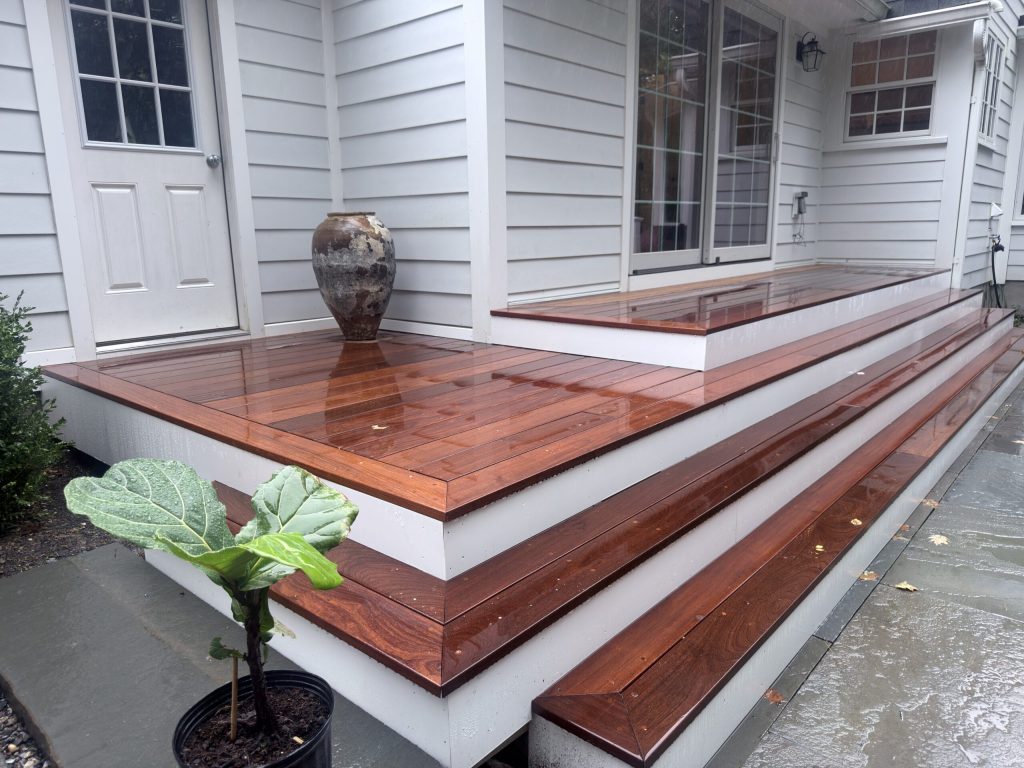
Cumaru, commonly called Brazilian Teak, is another exceptionally dense South American hardwood. It typically has medium-to-dark brown heartwood with reddish, golden, or purplish tones and an interlocked grain. Its natural color variation can create a visually active deck with strong hardwood character.
Cumaru is slightly less hard than Ipe in commonly published Janka values, but both species are far harder than many familiar domestic woods. In practical deck design, correct storage, acclimation, ventilation, spacing, fastening, and end sealing matter as much as the difference between their hardness numbers.
See our Cumaru decking page for more information.
Ipe vs Cumaru Appearance: Which Looks Better?
Appearance is one of the biggest reasons customers choose one species over the other.
Ipe appearance
Ipe usually presents a more refined brown palette, with colors ranging from olive and reddish brown to deeper chocolate tones. Grain can be straight, irregular, or interlocked, and some boards show darker streaking.
Cumaru appearance
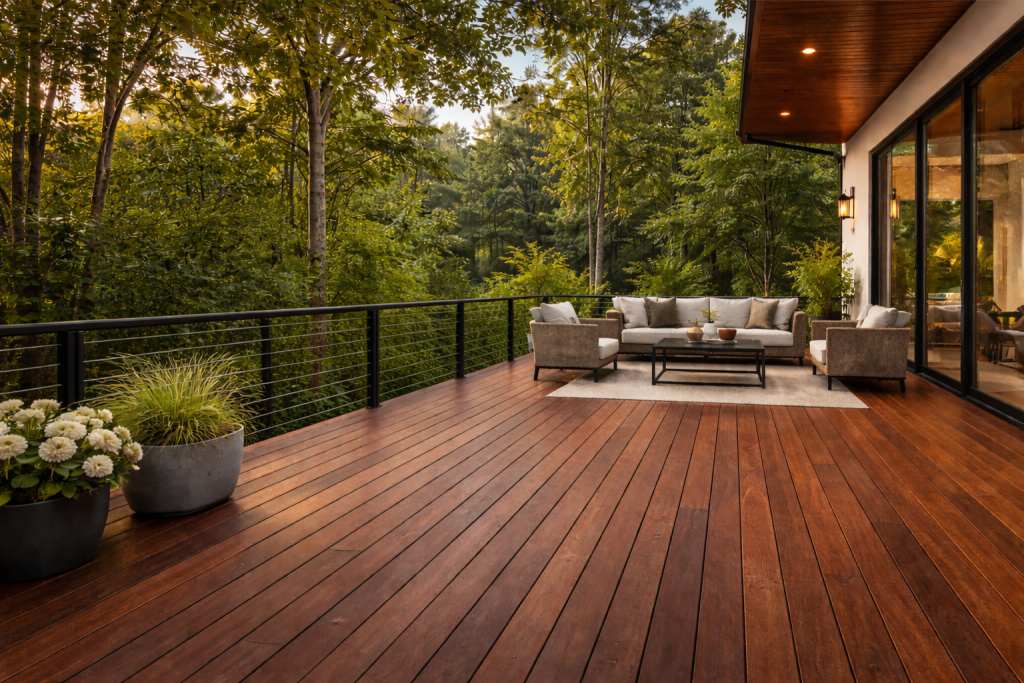
Cumaru often appears warmer and can show stronger variation from board to board. Reddish-brown, golden-brown, and deeper brown tones may appear in the same project. Customers who want a deck with more visible natural variation often prefer Cumaru.
Both woods can weather toward a silver-gray patina when left unfinished outdoors. If preserving more of the original brown color is the goal, use a finish specifically intended for dense exterior hardwoods and follow the finish manufacturer’s maintenance instructions.
Which Is Harder: Ipe or Cumaru?
Both are extremely hard. Representative values published by The Wood Database list Ipe at approximately 3,490 lbf Janka hardness and Cumaru at approximately 3,330 lbf. That makes Ipe slightly harder in this comparison, but the practical takeaway is that both are demanding materials that require appropriate blades, bits, screws, and installation techniques.
Hardness is useful, but it should not be the only deciding factor. Dimensional movement, grain, board quality, moisture condition, project exposure, ventilation, and fastening strategy can have a larger effect on how a finished deck performs.
Ipe vs Cumaru Cost: Which Is the Better Value?
Ipe generally occupies the higher-priced premium position. Cumaru is commonly selected when a customer wants a genuine tropical hardwood deck while controlling the material budget.
Do not compare a deck only by the price of one board. A realistic project budget can include:
- Decking boards
- Picture-frame and border boards
- Stair treads and risers
- Grooving or other milling
- Hidden fasteners or stainless-steel face screws
- End sealer
- Exterior hardwood finish
- Waste allowance
- Delivery or pickup logistics
The most accurate comparison comes from pricing the complete material list for the same deck design in both species.
Need a material estimate? Send Amazon Hardwoods your project square footage, preferred board profile, and ZIP code through our decking quote request.
Hidden Fasteners vs Face Screws
Your fastening method should be decided before ordering because it affects the board profile and hardware you need.
Grooved boards with hidden fasteners
Grooved decking allows compatible clips to sit between boards so the main deck surface has fewer visible fastener heads. This is a popular choice when appearance is the priority.
Square-edge boards with face screws
Square-edge decking can be face-fastened with appropriate exterior stainless-steel screws. Face fastening is also commonly used on picture frames, borders, stairs, and other locations where hidden clips may not be practical.
Dense tropical hardwoods should be drilled and fastened according to the hardware manufacturer’s instructions. Correct edge distance, pilot-hole sizing, screw type, board spacing, and end sealing all matter.
Ipe vs Cumaru for Connecticut and New York Decks
Northeast decks experience summer heat, winter cold, rain, snow, freeze-thaw cycles, and seasonal humidity changes. Both Ipe and Cumaru can be used successfully in these conditions when the deck is properly designed and installed.
For Connecticut and New York projects, pay particular attention to:
- Airflow beneath and around the deck
- Proper board spacing for the material and site conditions
- Correct joist spacing for the chosen board profile
- Acclimation and storage before installation
- Sealing freshly cut board ends
- Using hardware suitable for dense exterior hardwood
- Keeping leaves, dirt, and standing debris from accumulating on the surface
Amazon Hardwoods offers hardwood decking pickup and delivery in Connecticut and New York, including service for contractors and homeowners planning projects throughout the region.
Maintenance: Ipe vs Cumaru
Maintenance depends largely on the appearance you want. If you are comfortable with a natural silver-gray patina, routine cleaning may be the main cosmetic maintenance. If you want to retain more of the original brown color, periodic cleaning and reapplication of a compatible exterior hardwood finish may be needed.
Before applying any finish, follow the product manufacturer’s preparation and application instructions. Dense hardwoods do not always behave like pressure-treated lumber, cedar, or softwood decking.
Which Should You Choose?
Choose Ipe if: you want a premium tropical hardwood, prefer its darker and often more refined appearance, and are comfortable paying more for the material.
Choose Cumaru if: you want a dense tropical hardwood with warmer color variation and are looking for a stronger value position compared with Ipe.
For many buyers, seeing actual boards is the fastest way to decide. Natural hardwood varies from board to board, and a phone or computer screen cannot fully show grain, tone, and surface character.
Frequently Asked Questions About Ipe vs Cumaru
Is Cumaru cheaper than Ipe?
In many markets, Cumaru is priced below Ipe, although actual pricing changes by board size, length, grade, milling, quantity, and market conditions. Compare complete project quotes rather than relying on a generic percentage difference.
Does Ipe last longer than Cumaru?
Both are naturally durable tropical hardwoods. Service life depends heavily on material quality, design, ventilation, exposure, installation, and maintenance, so fixed lifespan claims should be treated cautiously.
Can Ipe and Cumaru use hidden fasteners?
Yes, when boards are prepared with a compatible groove and installed with an appropriate hidden-fastener system. Confirm the board profile and clip system before ordering.
Do Ipe and Cumaru need to be pre-drilled?
For face-fastened applications, pre-drilling is commonly recommended because both woods are extremely dense. Follow the screw and hardware manufacturer’s installation requirements.
Will Ipe and Cumaru turn gray?
Yes. Like many exterior woods, both can gradually weather toward a silver-gray surface when exposed outdoors without a UV-maintenance finish.
Which is better for a Connecticut deck?
Either can be an excellent choice. Ipe is often preferred for premium projects, while Cumaru can provide excellent hardwood performance at a lower material cost. The right board profile, fastening method, ventilation, and installation details are critical for either species.
Get an Ipe or Cumaru Decking Quote
If you are deciding between Ipe and Cumaru, send us the information that matters most: project square footage, board size, grooved or square-edge preference, desired lengths, and ZIP code.
Amazon Hardwoods can help you compare the material requirements for both options and plan pickup or delivery for your project.
Request an Ipe or Cumaru decking quote
Technical references: U.S. Forest Products Laboratory, Wood Handbook; The Wood Database species profiles for Ipe (Handroanthus serratifolius) and Cumaru (Dipteryx odorata). Technical values can vary by species, specimen, moisture content, and test source.